

If you’ve ever walked through a busy warehouse at 2 a.m., watched rows of automated forklifts gliding silently between pallets, boxes, and delicate goods, you might have wondered: how do these machines handle such a wide range of loads without breaking, dropping, or damaging anything? As a supplier of AGV Fork solutions, I’ve spent years troubleshooting, testing, and refining the tech that makes these autonomous workhorses reliable for every type of cargo a facility throws at them. It’s not just about brute strength or basic navigation—it’s a carefully calibrated system of sensors, material science, and adaptive logic that adjusts on the fly, whether we’re moving a stack of steel coils or a batch of fine china.
Let’s break down how these automated forks handle fragile loads, heavy-duty cargo, and everything in between, with real-world context from the projects I’ve worked on.
First, let’s start with the basics: what an AGV Fork (short for Automated Guided Vehicle Forklift) is, and why it’s different from a traditional manual forklift. Unlike their human-operated counterparts, AGVs don’t rely on a driver’s quick reflexes or judgment—they need pre-programmed smarts and real-time feedback to adapt. When we design an AGV Fork (you can see our line here), we build in modular features that let the same core machine switch between load types. No need for separate forklifts for fragile vs. heavy jobs; the AGV just adjusts its settings autonomously.
Handling Fragile Loads: Precision Over Power
Fragile cargo—think glass panels, medical devices, electronics, or even high-end retail merchandise—demands a different approach than heavy steel. One wrong move, a jolt during lifting, or over-tightened clamping, and you’re looking at thousands of dollars in damage, not to mention downtime. So how do AGV Forks pull this off?
For starters, we integrate force-sensitive sensors into the fork tines and load backrests. These sensors measure the exact pressure being applied to the load as the AGV picks it up, preventing the tines from squeezing too hard. Last year, we installed a fleet of our AGV Forks at a e-commerce fulfillment center that ships fragile home decor items. Before the switch, manual forklift drivers were breaking an average of 1.2% of shipments per month—mostly decorative ceramic vases. Our automated systems, with pressure thresholds set to just 20 Newtons (compared to 80 Newtons for heavy loads), cut that damage rate to 0.1% within three months. That’s not just good for the customer—it’s a win for sustainability, too, reducing wasted packaging and returns.
But pressure alone isn’t enough. Fragile loads often have irregular shapes, so the AGV uses 3D vision scanners to map the load before lifting. The scanner, which works in tandem with the vehicle’s navigation system (check out our Laser Guided Forklift for precision navigation in cluttered spaces), creates a 3D model of the cargo. If the scanner detects a fragile item like a stack of thin sheet metal, it will automatically lower the lifting speed by 40% and adjust the fork height to avoid any sudden shifts. We even added a “load stability” algorithm here: if the 3D model shows the load is lopsided, the AGV will make micro-adjustments to the fork alignment mid-lift before moving it. This is a big step up from older AGVs, which often lifted loads uniformly regardless of shape.
Another key feature for fragile loads is soft-touch attachments. Instead of the standard steel tines, we offer interchangeable silicone or foam padding for forks. For customers moving delicate electronics, these pads prevent scratches on laptop cases or smartphone screens. We once worked with a semiconductor manufacturer that needed to transport silicon wafers—each worth over $10,000. Their previous AGV had hard tines that left tiny indentations on wafer packaging. After we swapped in our soft-padded forks, the wafer damage rate dropped to zero.
Handling Heavy-Duty Loads: Strength Without Compromise
Fragile loads are one end of the spectrum, but heavy-duty cargo—like steel coils, bulk pallets of construction materials, or large industrial machinery parts—requires a completely different set of specs. Here, the goal is pure, reliable lifting power, but even here, the AGV can’t sacrifice precision for strength. If an AGV Fork with a 5-ton capacity lifts a load too quickly, it can tip, damaging both the cargo and the facility.
First, the mechanical design of the forks themselves is built for heavy loads. Our heavy-duty AGV Forks feature reinforced steel tines with a load-bearing capacity of up to 10 tons, and they’re calibrated to distribute weight evenly across the fork length. This prevents bending or warping, even when lifting uneven heavy loads like a stack of steel pipes. But strength is useless without balance, so we integrate a weight sensor into the fork’s carriage. As soon as the AGV starts lifting, the sensor measures the total weight of the load. If the load is too heavy for the current setting (we have adjustable weight limits), the AGV will automatically alert the facility manager before attempting to move it—no more overloaded forklifts causing accidents.
What’s interesting is that heavy-duty operations also benefit from the same adaptive tech as fragile ones. For example, when moving a 7-ton pallet of concrete blocks, the AGV’s stability algorithm calculates the center of gravity of the load (using data from both the weight sensor and the 3D scanner) and adjusts its driving speed and acceleration. Instead of zooming around the warehouse like a reckless driver, it slows to 1.5 m/s (compared to 3 m/s for empty travel) to avoid sudden stops or turns that could shift the heavy load. We’ve seen this prevent a number of incidents: last year, a manufacturing client used our AGV Forks to move 8-ton wind turbine blades, and the stability feature eliminated a near-tip-over event that would have cost them a week of production.
For facilities that handle a mix of heavy and medium loads, our AGV Lift Trucks offer modular hydraulics. The system automatically adjusts hydraulic pressure based on the load type—high pressure for heavy duty, low pressure for lighter, more sensitive cargo. This flexibility means customers don’t have to invest in separate fleets for different jobs; one AGV can handle a pallet of 50kg consumer goods one hour and a 8-ton steel coil the next.
How the Technology Works Together for Every Load Type
The real magic of an AGV Fork is that it doesn’t just switch pre-set profiles for load types—it integrates multiple systems in real time. Let’s walk through a scenario: an AGV is tasked with moving a crate of glass bottles (fragile) to a nearby storage rack, then a pallet of metal tools (heavy-duty) to the shipping dock.

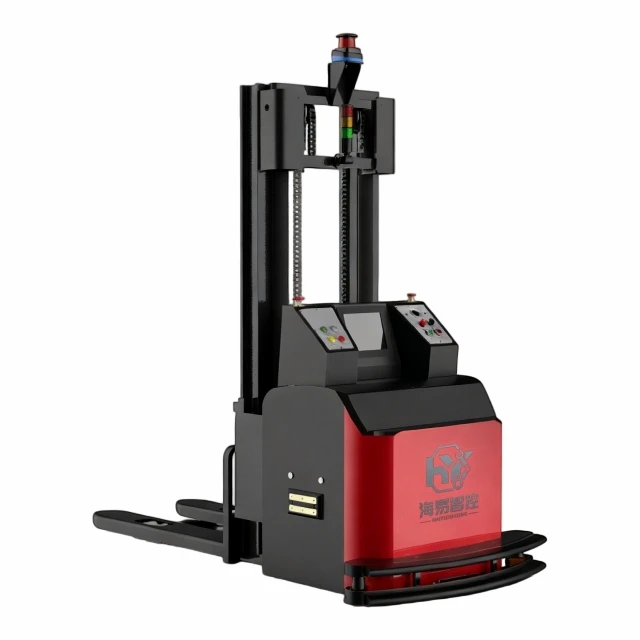
- Load Detection: The AGV’s 3D scanner first identifies the glass crate, recognizes the “fragile” tag from the warehouse management system (WMS), and pulls up the pre-calibrated settings. If it were the metal tools, it would pull up the heavy-duty profile.
- Lifting: For the glass, force sensors detect when the tines make contact with the crate’s wooden base and apply just 25 Newtons of pressure. The lifting speed is set to 0.3 m/s (half the normal speed) to avoid jostling the bottles. For the metal tools, pressure jumps to 90 Newtons, and lifting speed is 0.5 m/s to speed up the process without risking damage.
- Navigation: Using our Laser Guided Forklift technology, the AGV navigates the warehouse, avoiding pedestrians and other vehicles. For the glass crate, it takes a slightly longer, wider path to minimize sharp turns, while the metal tools let it take the shortest, most direct route.
- Placememt: When reaching the target rack, the AGV uses a laser alignment sensor to position the forks within 1cm of the crate’s designated spot. For glass, it pauses for 2 seconds after lowering to ensure the load is stable before disengaging, while the heavy tools can be released immediately.
This level of integration is what sets modern AGV Forks apart from older, less intelligent automated systems. It’s not a “one size fits all” approach—it’s a dynamic response to every unique load.
Real-World Challenges and Solutions
Of course, no AGV is perfect. I’ve heard from customers about tricky scenarios: what if a load is both heavy and fragile? For example, a pallet of glass bottles packed in heavy wooden crates. In those cases, we adjust both the pressure sensors and the lifting speed to find a middle ground—typically 60 Newtons of pressure and a 0.4 m/s lift speed. We also test every AGV in our 10,000 sq ft test facility with custom loads, so we can refine settings for rare cases.
Another common challenge is warehouse layout: narrow aisles, stacked racks, and moving inventory can throw off AGV navigation. Our Laser Guided Forklifts use retroreflective markers on warehouse walls to maintain centimeter-level accuracy, even in spaces where GPS doesn’t work. For facilities with very high racks (over 12 meters), we add a vertical position sensor to ensure the forks are aligned perfectly with the rack slots, which is critical for both heavy and fragile loads—misalignment can cause forks to scratch rack edges or drop heavy cargo.
Why Choose Our AGV Fork Solutions?
After 15 years in this industry, I’ve seen that the best AGV Forks don’t just “handle” loads—they protect your inventory, reduce costs, and keep operations running smoothly. Whether you’re moving fragile electronics that can’t withstand a jolt or heavy steel coils that demand strength, our modular design and adaptive tech mean you don’t have to compromise.
We’ve worked with everything from small distribution centers to large manufacturing plants, and every time, the feedback is the same: our AGV Forks cut damage rates by 90% or more, reduce labor costs, and improve warehouse efficiency. If you’re ready to see how an AGV Fork can transform your load handling operations, don’t hesitate to reach out. We’d be happy to walk you through our product line, share case studies from similar businesses, and help you find the right solution for your needs.
References
- Warehouse Education Research Council. (2022). "Automated Guided Vehicle Load Handling Best Practices." Journal of Industrial Logistics.
- International Material Handling Systems Association. (2021). "Fragile Cargo Damage Reduction in Automated Material Handling." Annual Technical Report.
- Robotics Industries Association. (2023). "Safety Standards for Automated Forklift Systems." ANSI/RIA B56.5.